Threshold Alerts & Toast Notifications
LocalTelemetry includes a customizable alerting system that warns whenever hardware temperatures, usage, frequency or power exceed (or drop below) configured thresholds.
Alert Types
LocalTelemetry supports two types of alerts:
- Visual Flashing Alert: The affected metric on the taskbar overlay flashes in a bright warning color to draw attention without interrupting your workflow.
- Desktop Toast Notification: A non-intrusive Windows toast popup displayed by the
LocalTelemetry.Notifier.exehelper process.
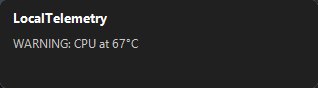 Figure: Standalone desktop toast warning popup.
Configuring Alert Thresholds
In Settings -> Alerts, you can enable and set individual limits. Defaults:
| Alert | Setting | Default |
|---|---|---|
| CPU Temperature | CPU Temp Threshold | 90°C |
| GPU Temperature | GPU Temp Threshold | 88°C |
| CPU Usage | CPU Usage Threshold | 95% |
| RAM Usage | RAM Usage Threshold | 92% |
| GPU VRAM Usage | GPU VRAM Threshold | 6000 MB |
| CPU Frequency (throttle) | CPU Freq Minimum | 800 MHz (below) |
| CPU Power | CPU Power Maximum | 65 W |
| GPU Frequency (throttle) | GPU Freq Minimum | 300 MHz (below) |
| GPU Power | GPU Power Maximum | 150 W |
Each alert is toggled independently. Frequency alerts fire when the CPU/GPU clock drops below the minimum (thermal throttling), while power alerts fire when package/board power exceeds the maximum.
Alert Cooldown & Throttle Controls
To prevent notification spam during gaming or rendering:
- Cooldown Interval: Minimum seconds between repeat notifications (Default:
60 seconds). - Fire Once Per Session: When enabled, each alert fires only once per app session and the cooldown is ignored.
The Standalone Notifier (LocalTelemetry.Notifier)
Desktop notifications are handled by a dedicated lightweight helper process (LocalTelemetry.Notifier.exe).
Why a separate process?
By isolating notifications in a secondary process:
- Toast popups never steal focus from full-screen games or applications.
- Heavy notification window animations do not affect the main overlay polling thread.
How it communicates
The main app launches the notifier with the parent process ID as its first command-line argument (used purely to track the app's lifetime and exit when it closes). Alert payloads (title, body, action) are delivered over a named pipe (LocalTelemetryNotifier), so no toast data is passed through command-line arguments.